
The Real Tax Gap Between LLCs and S Corps
According to Data
Switching from an LLC to S corporation status marks an important milestone in the life cycle of a business. Most comparisons focus on one number: how much self-employment tax is saved by an S corp election. That number is real, but it is only half the equation. This report estimates what an LLC and an S corp would each actually owe across different revenue ranges, then adds the piece most comparisons skip: what it actually costs to run an S corp in the first place.
Key Highlights
Among 1-800Accountant clients, profitability climbs sharply with revenue for both entity types. Below $50,000, most businesses of either type report a loss.
Using 2026 IRS tax rates, an S corp's estimated federal tax bill is lower than an LLC's across every profitable revenue range, but the dollar gap only becomes significant once net income clears approximately $100,000.
Published, credible sources put S corp tax preparation at roughly $500 more per year than a Schedule C return. This is before payroll processing and reasonable-compensation documentation are factored in.
Several states, including California, charge an S corp an entity-level tax on top of federal obligations that a default LLC does not carry.
At the lowest revenue range, the added cost of running an S corp can equal or exceed the entire estimated federal tax savings, which is why the election tends to pay off later than the headline tax-savings figure suggests.
About This Data
The figures in this report come from 1-800Accountant's tax year 2025 client data, based on a combined sample of 6,908 small business owners with reported revenue above $0. Revenue and expenses are self-reported, not audited against filed returns. That sample splits into two groups: S corp filings and Schedule C filers, meaning sole proprietors and single-member LLCs, which file identically. Multi-member LLCs file partnership returns and are excluded from both groups. All figures reflect our client base for one tax year, not a random sample of U. S. businesses.
Profitability and Net Income by Revenue Range
Profitability climbs steeply with revenue on both sides. Below $50,000, most businesses of either type report a loss. From $100,000 up, roughly three-quarters or more are profitable in every range.
S Corp Clients
Revenue Range | Median Net Income | Profitable (%) |
|---|---|---|
Under $50K | -$11,772 | 21% |
$50K – $100K | $5,875 | 60% |
$100K – $150K | $22,543 | 71% |
$150K – $250K | $34,589 | 73% |
$250K and up | $95,691 | 80% |
Source: 1-800Accountant client data, tax year 2025.
Schedule C Filers (Sole Proprietors and Single-Member LLCs)
Revenue Range | Median Net Income | Profitable (%) |
|---|---|---|
Under $50K | -$6,450 | 28% |
$50K – $100K | $23,945 | 72% |
$100K – $150K | $60,437 | 84% |
$150K – $250K | $71,771 | 82% |
$250K and up | $92,163 | 78% |
Source: 1-800Accountant client data, tax year 2025.
Net income is not directly comparable between the two groups. An S corp's net income is what remains after owner and employee wages are deducted as business expenses, while a sole proprietor's net income is the owner's entire take before any such deduction. The following sections instead build a comparison on a common income basis.
What the S Corp Election Is Actually Buying
An S corp election does not eliminate all taxes. It simply changes which portion of an owner's income is subject to payroll tax. Shareholder-employees must take a reasonable salary before taking any distributions, and the IRS weighs training, duties, time devoted, and comparable industry pay to decide whether that salary is legitimate. Like employee wages, an owner's salary is subject to payroll tax. Distributions generally are not, which is where the tax advantage comes from. A Schedule C filer, by contrast, owes self-employment tax on the entire net profit of the business. Our guide to how self-employment tax works for S corps walks through the mechanics in more detail.
The salary-versus-distribution split is an estimate built on a practitioner convention (40% salary, 60% distribution on profitable S corps), not a measured figure or IRS guidance. Figures are rounded to the nearest $100 to reflect their precision.
Revenue Range | Est. Salary | Est. Distribution |
|---|---|---|
Under $50K | $3,800 | $5,700 |
$50K – $100K | $11,600 | $17,400 |
$100K – $150K | $17,900 | $26,800 |
$150K – $250K | $29,100 | $43,700 |
$250K and up | $145,200 | $217,800 |
Estimates computed only on profitable S corp clients in each range, using a 40/60 salary-to-distribution convention. Not a substitute for a return-specific calculation.
Estimated Taxes Owed: LLC vs. S Corp by Revenue Range
Using the median S corp net income for each revenue range as a representative profit level, here is what an LLC (Schedule C filers) and an S corp would each be estimated to owe in federal tax for 2026, applying that year's IRS tax brackets, standard deduction, and the 20% qualified business income (QBI) deduction. Both scenarios assume a single filer taking the standard deduction, with no other income, dependents, or itemized deductions. The LLC figure combines self-employment tax with federal income tax. The S corp figure combines payroll tax on the estimated salary (using the 40/60 split) with federal income tax on salary plus distribution.
Revenue Range | Net Income Used | Est. LLC Tax Owed | Est. S Corp Tax Owed | Est. Difference |
|---|---|---|---|---|
Under $50K | -$11,772 | $0 | $0 | $0 |
$50K – $100K | $5,875 | $830 | $360 | $470 |
$100K – $150K | $22,543 | $3,251 | $1,753 | $1,498 |
$150K – $250K | $34,589 | $5,849 | $3,589 | $2,260 |
$250K and up | $95,691 | $20,343 | $15,552 | $4,791 |
Estimates only, for illustration. Uses 2026 federal single-filer tax brackets and standard deduction ($16,100) per IRS Revenue Procedure 2025-32, the 2026 Social Security wage base ($184,500), and the QBI deduction. Excludes state income tax and the added costs of running an S corp covered later in this report. Under $50K range shown at $0 because median net income there is negative.
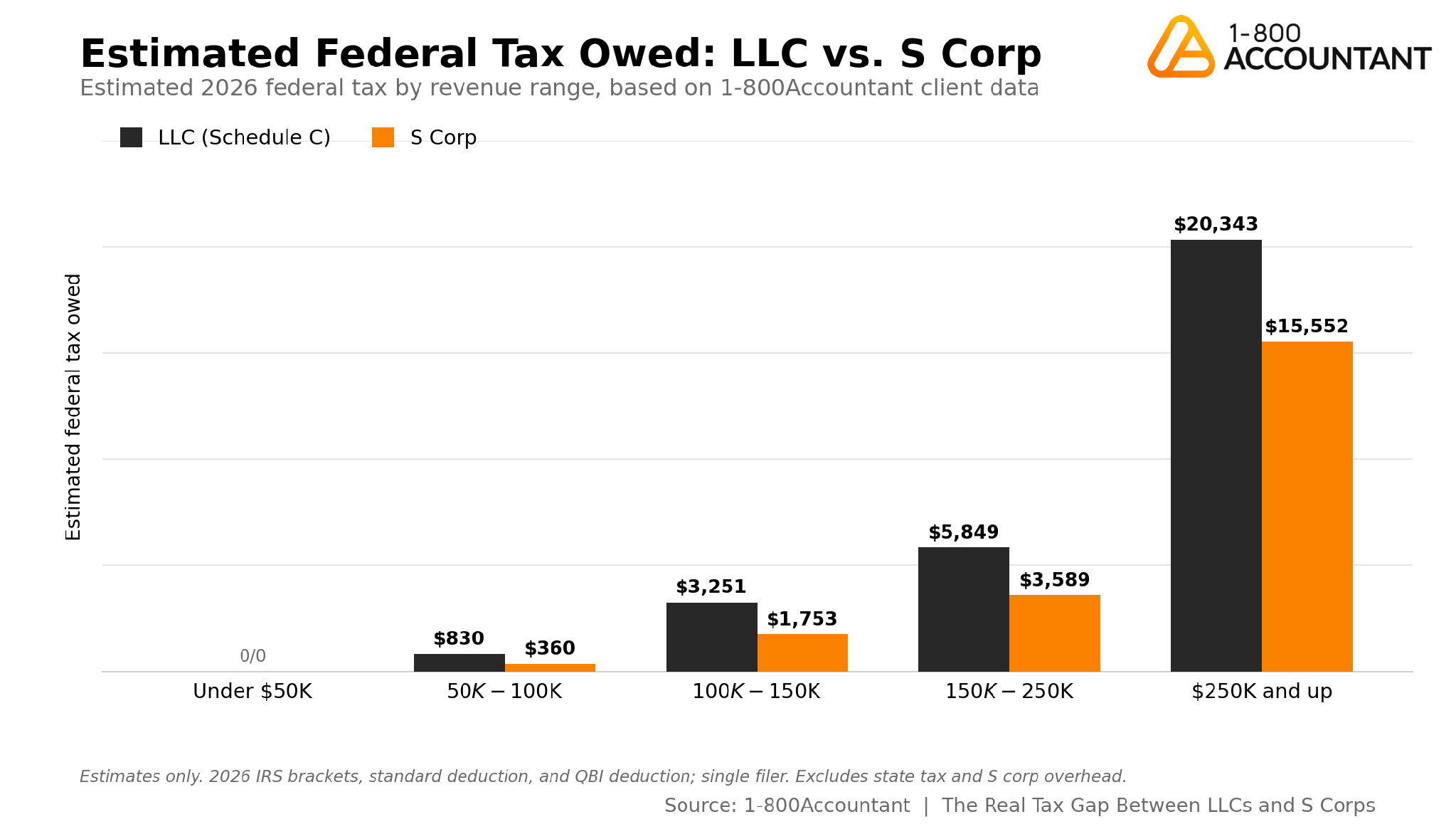
The estimated federal tax owed is lower in the S corp scenario across every profitable revenue range, which is exactly the case in most S corp comparisons. But the dollar difference is modest until net income clears roughly $100,000. At $22,543 of net income, the estimated gap is $1,498; below that, in the $50,000 to $100,000 revenue range, it narrows to $470, small enough that the added costs of operating as an S corporation can erase most or all of it.
Hidden Costs to Note for S Corps
The estimated tax comparison is what most S corp discussions will lead with. It is real, but it does not reflect the full costs of the election. Running an S corp imposes recurring obligations that a default LLC taxed as a sole proprietorship does not. Reliable, isolated data on these costs weren't available for 1-800Accountant's own client base, so the figures are drawn from published, third-party sources.
A Second Tax Return, Not a Simpler One
An S corp files IRS Form 1120-S, which is effectively an informational return, and distributes a Schedule K-1 to each shareholder. Each owner then uses a K-1 to report their share of income, losses, and deductions. The average fee to prepare a Form 1120-S can run well over $1,000, compared to roughly $500 for a Schedule C. That gap of $500 or more per year is a recurring cost, not a one-time setup fee, and it grows with multistate expansion and when more shareholders are added.
Payroll You Did Not Need Before
Paying a reasonable salary means running actual payroll, with withholding, quarterly IRS Form 941 filings, and a W-2 at year-end. Forbes Advisor puts small business payroll service pricing at a monthly base fee of $20 to about $200, plus monthly fees of $4 to $22 per employee or contractor. For a single owner-employee, that lands in the neighborhood of $500 to $1,000 a year at the low end, on top of the employer-side FICA match on the salary itself.
Reasonable Compensation Is a Compliance Obligation, Not a Formality
The IRS does not accept a fixed formula for reasonable salary. Its own guidance directs examiners to weigh training and experience, duties and responsibilities, time devoted to the business, and comparable pay for similar work. Getting this wrong carries real exposure: the IRS can reclassify distributions as wages, which brings back payroll tax on amounts that were never withheld, plus penalties and interest. Documenting a defensible salary and adjusting it annually, whether through a compensation study or an accountant's judgment, is an ongoing cost of staying compliant, not a one-time decision.
State-Level Taxes an LLC Does Not Owe
Several states tax S corps directly at the entity level. California is the clearest example: an S corp doing business there owes the greater of $800 or 1.5% of net income every year, even in a loss year, on top of federal tax. A default LLC taxed as a sole proprietorship in California does owe the $800 minimum franchise tax, but does not owe the 1.5% net-income-based portion.
What Does Not Change: Formation Cost
One place S corps and LLCs land close together is initial setup. State filing fees for forming either an LLC or a corporation average around $130, and range from about $35 to $500 depending on the state. Formation is a one-time cost either way, so it is not the reason one structure ends up cheaper than the other over time. The recurring costs make the difference.
Why the Under-$50K Range Argues Against Electing
Only 21% of S corp clients under $50,000 of revenue were profitable, and the estimated salary in that range, $3,800, is thin enough to invite exactly the kind of IRS scrutiny that reasonable-compensation rules exist to catch. Add a second tax return, a payroll system, and in many states a minimum entity tax, and the numbers argue for staying a default LLC until profit is consistent enough to support a genuine salary and absorb the added overhead comfortably.
State Rules Can Move the Line
California is not the only state with entity-level rules for S corps, and requirements vary widely: some states charge a flat annual fee, others tax net income directly, and some do neither. An owner weighing the election should check their state's S corp filing requirements before assuming the federal tax math is the whole picture. Our guide to LLC versus S corp taxes and our breakdown of LLC tax rates cover the federal side in more depth.
Making the Election on the Full Picture, Not Half of It
The estimated tax comparison makes a real case for S corp status once profits are consistent, but that case only holds up when tax preparation, payroll, compliance, and state-level costs are counted alongside the federal tax savings, not left out of the math.
If you're on the fence or unsure if your revenue qualifies, expert support will help. A dedicated tax advisor can model the full picture for your business, determine if your target salary is reasonable, and compile state and federal obligations, so you can make a strategic S election with confidence.
This post is to be used for informational purposes only and does not constitute legal, business, or tax advice. Each person should consult his or her own attorney, business advisor, or tax advisor with respect to matters referenced in this post. 1‑800Accountant assumes no liability for actions taken in reliance upon the information contained herein.
Subscribe to our
exclusive newsletter
For tax tips, insights, and more,
curated to help your business grow.