
Most Independent Workers Say They Would Not Trade Their 1099 for a W-2

For millions of Americans, the question of whether to work for themselves or for an employer has a clear answer. And for those already doing it themselves, the answer is rarely a return to a traditional job.
In September 2026, we asked 4,068 of our clients at 1-800Accountant how they feel about working as an independent contractor or small business owner compared with being an employee. Roughly two out of three (65.7%) said they prefer working for themselves. Just 6.3% said they would rather return to W-2 employment, a gap of more than 10-to-1.
Key Highlights
Of the 4,068 clients we surveyed in September 2026, 65.7% prefer working for themselves and just 6.3% would rather return to W-2 employment.
Nearly half of respondents (48.7%) strongly prefer independent work, and 91% of those who stated a preference chose it over a traditional job.
Federal data shows a similar pattern, with 80.3% of independent contractors telling the BLS they prefer their arrangement.
Independent workers generally pay a combined 15.3% self-employment tax and are expected to make quarterly estimated tax payments.
Starting with payments made in 2026, the Form 1099-NEC and 1099-MISC reporting threshold rises from $600 to $2,000, though the income remains taxable.
A Department of Labor proposal from February 2026 would change the standard for classifying workers as independent contractors.
Nearly half feel strongly about it
The preference is clear. Almost half of all respondents (48.7%) indicated they strongly prefer working as a contractor or business owner, making it the most common answer. Only 76 people (1.9%) said they strongly prefer traditional employment. Put another way, for every respondent who strongly favors a W-2 job, about 26 strongly favor working for themselves.
When respondents who were neutral or unsure are set aside, the split becomes more pronounced: 91% of those who expressed a preference chose independent work.
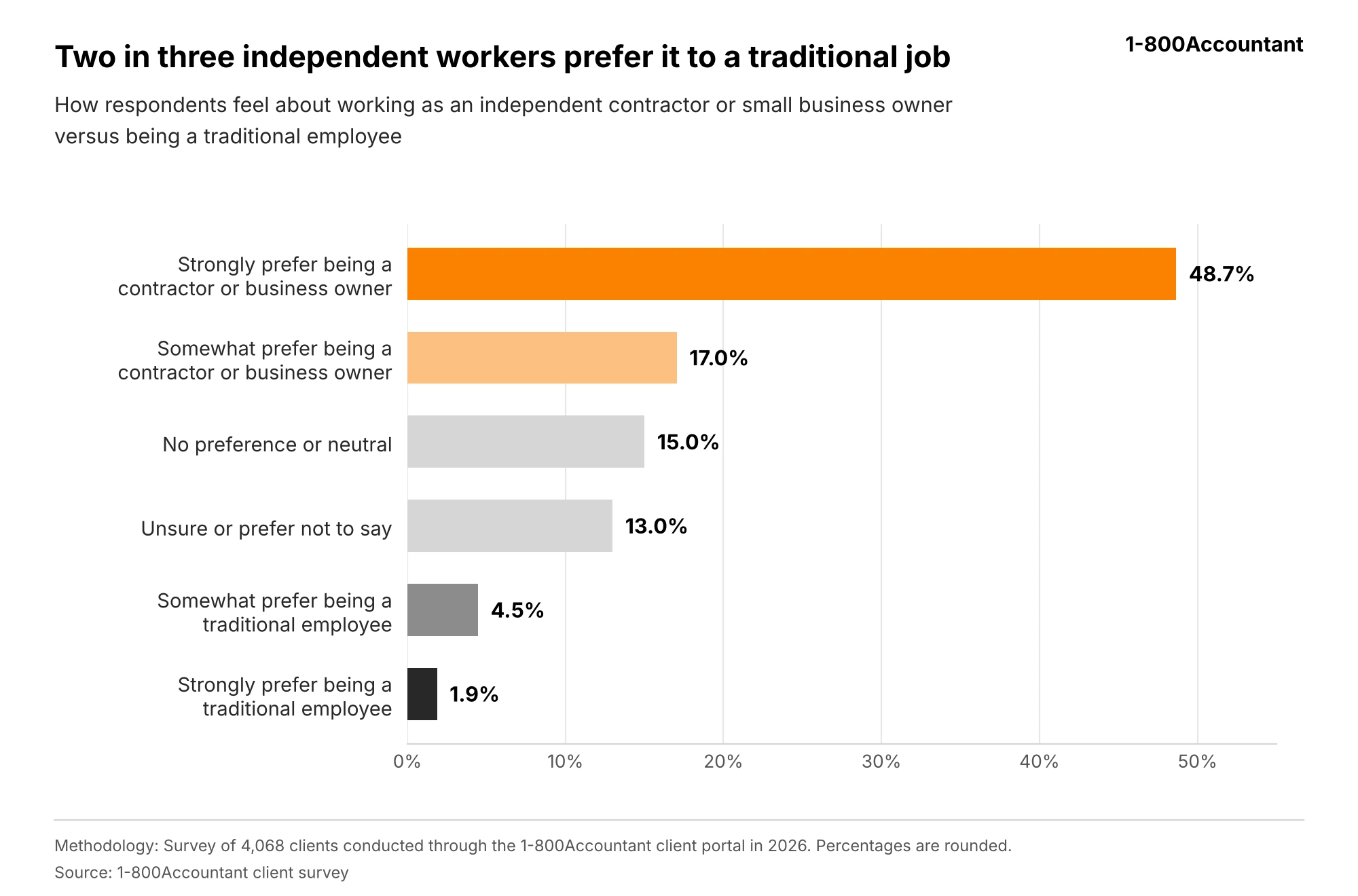
About 28% of respondents fell into the middle, either saying they had no preference (15%) or that they were unsure or preferred not to answer (13%). That group may include newer business owners still weighing the tradeoffs, as well as professionals who split their time between a salaried position and a side business.
Federal data points in the same direction
The results line up with the most recent government figures on independent work. In its Contingent and Alternative Employment Arrangements release, the Bureau of Labor Statistics found that 11.9 million people worked as independent contractors in their sole or main job in July 2023, representing 7.4% of total employment. That share was up from 6.9% in May 2017, the previous time the survey was conducted.
The BLS also asked about preference. Among independent contractors, 80.3% said they preferred their arrangement, while 8.3% said they would prefer a traditional role. On-call workers, by contrast, were split almost evenly, suggesting the appeal comes from running one's own work rather than from flexible scheduling alone.
Independence comes with a different tax system
Working for yourself changes how taxes work, and much of that shift lands on you. Employers withhold income tax from an employee's W-2 paycheck and split Social Security and Medicare contributions. Independent contractors generally pay both halves through self-employment tax, a combined 15.3% on net earnings, and are expected to calculate and send quarterly estimated tax payments throughout the year. The final 2026 quarterly installment is due by January 15, 2027.
Paperwork is changing too. Beginning with payments made in 2026, the threshold that triggers a Form 1099-NEC or 1099-MISC rose from $600 to $2,000. Fewer small payments will generate a form, but the income remains taxable, which puts most of the recordkeeping on the worker.
The picture is murkier for app-based gig workers. A rideshare or delivery driver can receive both a 1099-K for trip earnings and a 1099-NEC for bonuses and referrals, or no form at all, depending on how much they earn on each platform. The income is taxable in every case, 1099 or not.
Earnings also vary widely by field. Our 1099 Earnings Report, published in June 2026, found that typical revenue for an earning 1099 business ranged from about $850 to $77,000 across 31 industries, with a midpoint near $19,200. In 10 of those industries, the typical business reported more in expenses than in revenue.
Classification rules are in flux
The definition of who counts as an independent contractor has also been under review. In February 2026, the U. S. Department of Labor proposed a rule that would rescind its 2024 classification standard and largely return to the framework it adopted in 2021, which centers on how much control a business has over the work and the worker's opportunity for profit or loss. Advocates say the change would make legitimate contractor relationships easier to establish, while critics argue it could make it easier for companies to misclassify workers as contractors who would otherwise receive overtime and minimum wage protections. A final rule had not been published as of late October.
For the workers who have already made the move, the survey suggests the debate is less about whether independent work is worth it and more about how to manage everything that comes with it as they scale.
Managing the Tax Side of Working for Yourself
Most of the people we surveyed have already decided that independent work is worth it. Staying on top of self-employment tax, quarterly estimates, and recordkeeping is what keeps it that way. If you want a hand with that, explore our small business tax services to see what year-round support from a dedicated accountant looks like.
Methodology
We surveyed clients through the 1-800Accountant client portal in September 2026. A total of 4,068 clients answered the question, "All things considered, how do you feel about working as an independent contractor or small business owner versus being a traditional employee?" No respondents skipped it. Because respondents are clients of an accounting firm serving small businesses and self-employed individuals, results reflect people who currently work independently or own a business and are not representative of the overall U. S. workforce. Percentages are rounded.
This post is to be used for informational purposes only and does not constitute legal, business, or tax advice. Each person should consult his or her own attorney, business advisor, or tax advisor with respect to matters referenced in this post. 1‑800Accountant assumes no liability for actions taken in reliance upon the information contained herein.
Subscribe to our
exclusive newsletter
For tax tips, insights, and more,
curated to help your business grow.